
Moxa EDS-316 Series 16-Port Unmanaged Ethernet Switches With Relay Alarms
The Moxa EDS-316 Series is a line of 16-port unmanaged Ethernet switches whose relay output signals power failures and port breaks.
Most unmanaged switches give no warning when a power feed or a link drops. The EDS-316 wires that warning into a relay contact, so a 16-port industrial Ethernet switch can raise an alarm without any software.
The series includes 16 models, from copper-only units to versions with one or two fiber ports reaching up to 80 km, and most come with a wide-temperature -T twin.
What the EDS-316 Series Does Beyond Basic Switching
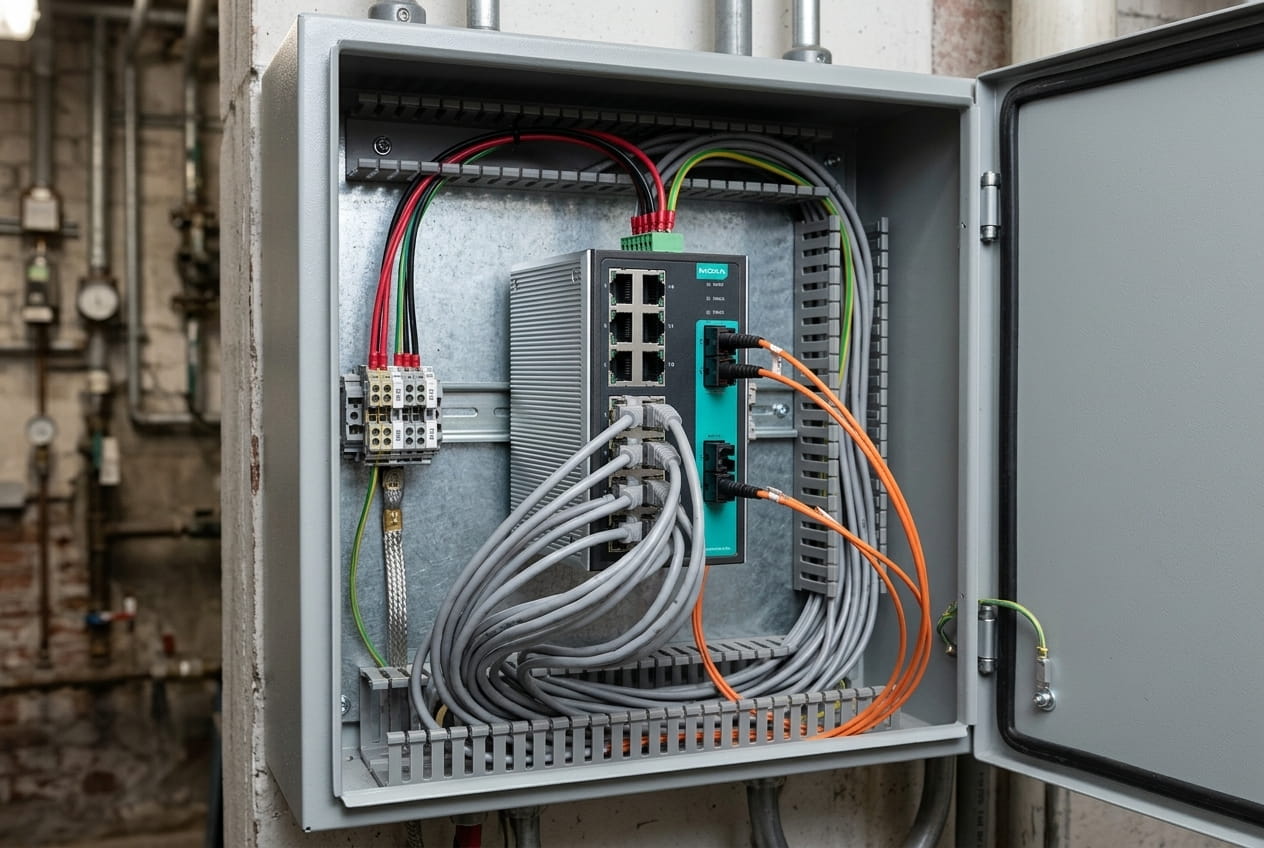
Picture a 16-port switch in a remote cabinet. When one of its redundant dual power inputs fails, the power failure alarm switches the relay output. When a monitored link drops, the port break alarm does the same, and DIP switches decide which ports count.
The relay output alarm is rated 1 A at 24 VDC, so it can drive a PLC input or a warning lamp directly.
Copper-only models carry 16 × 10/100BaseT(X) Ethernet ports, while fiber models pair 10/100BaseT(X) RJ45 ports with one or two 100BaseFX fiber ports. Broadcast storm protection, a 4K MAC table, and a 1.25 Mbits buffer handle the switching.
A rugged metal housing makes it a DIN-rail industrial Ethernet switch that can also be wall-mounted. The -T models are wide-temperature switches rated for -40 to 75°C.
EDS-316 Copper and Fiber Technologies by Industry
The EDS-316 uses standard Industrial Ethernet switching, so its copper and fiber ports work with any compliant device. Oil and gas and marine are included because of the series' hazardous-location and DNV approvals.
| Technology | Where It Applies | What It Gives the Project | Industries That Gain Most |
| 10/100BaseT(X) per IEEE 802.3 and IEEE 802.3u (Fast Ethernet) | All RJ45 ports | Copper links up to 100 m to PLCs, HMIs, drives, and cameras | Factory Automation, IP Surveillance, Marine |
| 100BaseFX over Multi-Mode Fiber | -M, -MM, and -MS models, SC Fiber Connector or ST Fiber Connector | Up to 4 km on OM1 or 5 km on 50/125 µm, immune to electrical noise | Factory Automation, Water and Wastewater, Oil and Gas |
| 100BaseFX over Single-Mode Fiber | -S, -SS, and -MS models, SC Fiber Connector | Up to 40 km, or 80 km on the EDS-316-SS-SC-80 | Oil and Gas, Water and Wastewater |
| IEEE 802.3x Ethernet Flow Control | Full-duplex links | Pause frames help prevent buffer overflow during traffic bursts | IP Surveillance, Factory Automation |
| Auto-Negotiation, Full/Half Duplex, Auto MDI/MDI-X | Every RJ45 port | Older and newer devices connect without manual speed or cable settings | Water and Wastewater, Factory Automation |
| Store-and-Forward Switching | All ports, with a 4K MAC table and 1.25 Mbits buffer | Checks every frame and drops corrupted ones before they spread | Factory Automation, Marine |
EDS-316 Series Applications From Factory Floors to Remote Sites
Sixteen ports and a hard-wired alarm make this series a fit for larger segments where a silent failure would cost time.
- Factory automation cells with up to 16 Ethernet devices in one cabinet, where the relay feeds a PLC alarm input.
- Industrial control systems at treatment plants and pump stations, giving basic industrial network monitoring of feeds and links without SNMP or software.
- Machine networking on large machines and skids, keeping every device on one switch.
- Industrial network expansion when an existing 5-port or 8-port switch runs out of ports.
- Industrial Ethernet connectivity between buildings or remote sites, up to 80 km over single-mode fiber.
- Harsh and hazardous industrial environments such as ATEX Zone 2 or Class I Division 2 areas, with -T models for cabinets between -40 and 75°C.
Compare All 16 EDS-316 Models by Ports and Fiber Reach
The 16 models differ in their fiber ports, fiber type and connector, and whether a wide-temperature -T version exists. All of them share the relay alarm, redundant dual power inputs, metal IP30 housing, and broadcast storm protection.
| Model | RJ45 Ports | Fiber Ports | Typical Fiber Reach | -T Version | Best Suited For |
| EDS-316 | 16 | None | None | EDS-316-T | Copper-only cabinets with up to 16 devices |
| EDS-316-M-SC | 15 | 1 multi-mode SC | 4 to 5 km | EDS-316-M-SC-T | One fiber uplink within a plant, on SC patch panels |
| EDS-316-M-ST | 15 | 1 multi-mode ST | 4 to 5 km | EDS-316-M-ST-T | The same uplink role on sites standardized on ST |
| EDS-316-MM-SC | 14 | 2 multi-mode SC | 4 to 5 km | EDS-316-MM-SC-T | Daisy-chaining cabinets with one fiber in and one fiber out |
| EDS-316-MM-ST | 14 | 2 multi-mode ST | 4 to 5 km | EDS-316-MM-ST-T | Daisy-chaining cabinets on ST fiber |
| EDS-316-MS-SC | 14 | 1 multi-mode SC, 1 single-mode SC | 4 to 5 km and 40 km | None | A local fiber link plus one long run to a remote site |
| EDS-316-S-SC | 15 | 1 single-mode SC | 40 km | EDS-316-S-SC-T | One remote site up to 40 km away |
| EDS-316-SS-SC | 14 | 2 single-mode SC | 40 km | EDS-316-SS-SC-T | A chain of remote sites, such as pump or well stations |
| EDS-316-SS-SC-80 | 14 | 2 single-mode SC, 80 km | 80 km | None | Remote sites up to 80 km apart |
Relay Alarms and Hazardous Approvals Set the EDS-316 Apart
As an industrial Ethernet switch with relay alarm, the EDS-316 handles fault reporting to hardware. The control system learns about a lost feed or link without a managed switch or any configuration.
It is also an industrial Ethernet switch for harsh environments, with Moxa listing ATEX Zone 2, Class I Division 2, and DNV approvals for the series. A 5-year warranty and UL 508 safety certification back it up.
Source Moxa EDS-316 Switches in the Middle East
Easy World Automation supplies the Moxa EDS-316 Series as a Moxa distributor in the Middle East. Wiring, DIP switch settings, and mounting are covered in the EDS-316 installation guide, which serves in place of an EDS-316 series user manual. Share the port count, fiber distances, and site temperature with a consultation request.
Moxa EDS-316 Series Questions Answered for Specifiers and Installers
1. What is the Moxa EDS-316 Series?
The Moxa EDS-316 Series is a family of 16-port industrial unmanaged Ethernet switches with a built-in relay alarm. The relay signals when a power feed fails or a network link drops, with no software involved. Models range from all-copper units to versions with one or two fiber ports.
2. How many Ethernet ports does the EDS-316 Series have?
Every EDS-316 switch has 16 ports. On copper-only models, all 16 are RJ45, and on fiber models, one or two of them are fiber instead.
3. Is the EDS-316 Series a managed or unmanaged Ethernet switch?
The EDS-316 is unmanaged. There's no IP address or web page to set up, and the switch starts working as soon as it's powered and cabled. The only settings are DIP switches that choose which ports the alarm watches.
4. What Ethernet speeds does the EDS-316 Series support?
EDS-316 copper ports run at 10 or 100 Mbps and pick the right speed automatically. Fiber ports run at 100 Mbps, and Gigabit isn't supported.
5. What port configurations are available in the EDS-316 Series?
The EDS-316 comes in three port layouts. A switch has 16 copper ports, 15 copper plus one fiber, or 14 copper plus two fiber. The comparison table above lists every model.
6. Does the EDS-316 Series support fiber Ethernet connections?
Yes, 14 of the 16 EDS-316 models have fiber ports. Only the EDS-316 and EDS-316-T are copper-only.
7. What types of fiber connections are available in the EDS-316 Series?
EDS-316 fiber ports come as multi-mode SC, multi-mode ST, or single-mode SC. One model, the EDS-316-SS-SC-80, uses long-haul single-mode SC ports.
8. Does the EDS-316 Series support single-mode and multi-mode fiber?
Both are available across the EDS-316 range, depending on the model. Multi-mode is the usual choice inside a plant, while single-mode is for longer runs between sites. The EDS-316-MS-SC has one port of each.
9. What SC and ST fiber connector options are available in the EDS-316 Series?
SC is available for both multi-mode and single-mode fiber on the EDS-316, while ST is offered only on the multi-mode -M-ST and -MM-ST models. Pick the connector that matches the patch panels already on site.
10. What is the maximum fiber transmission distance supported by the EDS-316 Series?
The longest EDS-316 fiber link is 80 km, on the EDS-316-SS-SC-80. Other single-mode models reach 40 km, and multi-mode models reach about 4 to 5 km depending on the fiber. For single-mode links, Moxa recommends an attenuator to protect the receiver from too much optical power.
11. What are the power requirements of the EDS-316 Series?
The EDS-316 runs on 12, 24, or 48 VDC, wired through a removable terminal block that also holds the alarm relay. It draws about 0.34 to 0.40 A at 24 VDC, depending on the model. Reverse polarity and overload protection are built in, and the power supply is sold separately.
12. Does the EDS-316 Series support redundant dual power inputs?
Every EDS-316 model has two power inputs, so if one supply fails, the switch keeps running on the other. The alarm relay reports the lost feed at the same time. That makes it an industrial Ethernet switch with redundant power that also flags when the backup is in use.
13. What DC input voltage does the EDS-316 Series support?
The EDS-316 works with any DC supply from 9.6 to 60 VDC, which covers standard 12, 24, and 48 VDC systems. It has no AC input.
14. What is the operating temperature range of the Moxa EDS-316 Series?
Standard EDS-316 models work from -10 to 60°C (14 to 140°F), and -T models from -40 to 75°C (-40 to 167°F). All models can be stored from -40 to 85°C.
15. What is the difference between standard and wide-temperature EDS-316 models?
The main difference between standard and -T EDS-316 models is the temperature rating. A -T unit is the wide-temperature industrial Ethernet switch for unheated or outdoor cabinets, with the same ports as its standard version. Two models, the EDS-316-MS-SC and EDS-316-SS-SC-80, have no -T version.
16. Does the EDS-316 Series provide power failure and port break alarms?
The EDS-316 provides both alarms, and either one triggers the same relay output. The relay shows that a fault exists, and the cause is then checked at the switch.
17. How does the relay warning function work on the EDS-316 Series?
The EDS-316 relay is a single contact rated 1 A at 24 VDC that switches when an alarm occurs. It can be wired to a PLC input, an alarm panel, or a warning light. For anything drawing more than 1 A, use an interposing relay.
18. How does the EDS-316 Series detect power failures and port breaks?
The EDS-316 monitors both power inputs and the link status of selected ports. DIP switches set which ports are watched, so a port that is often unplugged can be left out of the alarm.
19. Does the EDS-316 Series support broadcast storm protection?
Every EDS-316 model has broadcast storm protection, and it works automatically. It helps keep a faulty device or a looped cable from flooding the network.
20. Can the EDS-316 Series be mounted on a DIN rail?
Yes, the EDS-316 mounts on a standard DIN rail. It measures 80.1 mm wide, 135 mm tall, and 105 mm deep and weighs 1.14 kg, so leave space in front for the cables.
21. Can the EDS-316 Series be wall mounted?
Yes, the EDS-316 can be wall-mounted with an optional kit sold separately. The kit's plates fit on the back of the switch, which then screws to a wall or panel.
22. What is the IP rating of the EDS-316 Series?
The EDS-316 is an IP30 industrial Ethernet switch. IP30 keeps out objects larger than 2.5 mm but not water or fine dust, so the switch needs to sit inside a cabinet.
23. What certifications does the EDS-316 Series have?
The EDS-316 Series is approved for hazardous locations (ATEX and Class I Division 2) and for maritime use (DNV). It also carries UL 508, UL 60950-1, CSA C22.2 No. 60950-1, and EN 62368-1 safety approvals, plus FCC Part 15B Class A and EN 55032/35 for EMC. For hazardous or marine projects, check the marking on the model's label.
24. Is the EDS-316 Series suitable for hazardous locations?
Yes, the EDS-316 is approved for ATEX Zone 2 and Class I Division 2 areas, but not for Zone 1 or Division 1. It must sit in an enclosure that opens only with a tool. Installation or servicing should happen only when the area is known to be safe.
25. Does the EDS-316 Series support ATEX Zone 2 applications?
ATEX Zone 2 applications are supported, and the certificate details are in the EDS-316 quick installation guide. Zone 2 means an explosive gas atmosphere is unlikely in normal operation and short-lived if it does occur.
26. Does the EDS-316 Series support Class I Division 2 applications?
The EDS-316 is approved for Class I Division 2, gas Groups A, B, C, and D. Division 2 areas are those where flammable gas or vapor is present only if something goes wrong, such as a leak.
27. How do I choose the right EDS-316 model for my application?
Choosing an EDS-316 model starts with how many fiber links are needed: none, one, or two. Use multi-mode for runs within a plant and single-mode for longer distances, then match SC or ST to the existing patch panels. If the cabinet can get colder than -10°C or hotter than 60°C, pick a -T model.


